
Fence Company in Silverton, Oregon
Privacy fences, cedar, chain link, gates and repairs — built to your property line by a licensed Oregon contractor who answers his own phone. Free estimates.
- CCB #257281Oregon licensed & insured
- Locally ownedBased in Albany, working the valley
- You talk to the builderNot an out-of-state call centre
- Free estimatesWe follow up to learn the project
Get your Silverton fence quoted
Tell us what you want built, repaired or replaced. Free estimate, straight answers, and a real licence number you can look up.
Thanks — that's with us.
We'll call you back to set up a time to come out and measure. If it's urgent, call (458) 278-2166 and you'll get a person.
What we build in Silverton
Fencing is the core of the business — not a sideline bolted onto a general remodelling company.
Privacy fences
Cedar dog-ear, board-on-board and shadow box, built to sit level along an uneven line.
Cedar & wood
Decorative tops, cap and trim, and horizontal styles when the look matters as much as the screening.
Chain link
Straightforward, durable containment for pets, yards and side runs.
Gates
Walk gates and double drive gates hung so they still swing true in a year.
Fence repair
Storm damage, leaning posts, rotted boards and sagging gates — repaired rather than replaced where that is the honest answer.
Decks & siding
The same crew handles decking and siding when the exterior needs more than a fence.
Silverton's fence rules, in plain English
Most fence trouble in Silverton starts in the front yard and at corners. Two things catch people out: out front you get 42 inches, not four feet — and six feet is a hard ceiling in the R-1, R-5, RM-10 and RM-20 zones, so no building permit buys you an eight-foot fence. Here is what the City actually requires, so you know before anyone digs a hole. Every figure here is Silverton’s own code and applies inside the city limits — neighbouring cities set their own rules.
| Where the fence runs | Max height | Catch |
|---|---|---|
| Interior side and rear lines — interior and corner lots alike | 6 ft | The most SDC Table 2.2.120.A allows in the R-1, R-5, RM-10 and RM-20 zones. No building permit buys you more. |
| Front yard — or anywhere forward of your front facade | 42 inches | Three and a half feet. SDC 3.2.500(B)(1) counts the combined height of the fence plus any retaining wall, landscape rock or railroad tie under it, measured from the grade closest to the street right-of-way. |
| Corner lot front yard, within 50 ft of the through-curb intersection | 42 inches | Measured 50 ft from where the curbs carry through the intersection, not from your property corner. Table 2.2.120.A points you to Figure 3.2.500 for that geometry. |
| Corner lot front yard, beyond 50 ft of the intersection | 6 ft | Only if the fence is also set back at least 5 ft from the property line — SDC 3.2.500(B)(1) makes both conditions apply. Miss either one and you're back to 42 inches. |
| A rear line that fronts a street (reverse frontage lot) | 42 in or 6 ft | Six feet only if you leave a 5 ft landscaped buffer between the fence or wall and the sidewalk, per Table 2.2.120.A. Without that buffer it's 42 inches, even though it's your back yard. |
| Along an alley | 6 ft | Table 2.2.120.A allows six feet here — but vision clearance still applies where the alley meets the street. |
| Commercial districts (DC, GC, DCF) at a street right-of-way | 42 inches | Table 2.3.120 sets the same 42 inches as a house at the street line. It sets no interior side or rear limit for those districts. On anything other than a single-family or duplex lot, the material also goes through design review. |
Six feet is a zoning ceiling, not a permit threshold. SDC 3.2.500(A) says a building permit is required for fences greater than six feet, which reads like a permit lets you go taller. It doesn't. That same section also requires you to meet the height limits of your zoning district, and Table 2.2.120.A — one chapter over, in SDC Chapter 2.2 — independently caps side and rear fences at six feet in R-1, R-5, RM-10 and RM-20. So no building permit raises that number. The one written path around it is the line printed just above the table: those standards may be modified with approval of a planned development, which is a land-use application, not a permit you pick up at the counter. Two footnotes worth knowing: one arbor, gate or similar garden structure per yard may reach eight feet tall and six feet wide under SDC 3.2.500(B)(3) if it's clear of the vision clearance area, and anything over six feet has to be landscape-screened under SDC 3.2.500(D)(3).
If you're on Acreage Residential (AR) land, ask before you build — and corners are where this gets strict. The six-foot figure comes from Table 2.2.120.A, and that table has columns for R-1, R-5, RM-10 and RM-20 only. AR sits in the same chapter under a different table — Table 2.2.120.B — and that one contains no fence height rows at all. SDC 3.2.500(A) sends you to Tables 2.2.120.A and 2.3.120 and never to 2.2.120.B. We're not going to tell you what your limit is when the code doesn't say: call Silverton Planning before you order material for an AR lot. Silverton doesn't just lower the height near an intersection. SDC 3.2.500(A) says every fence must be located outside any vision clearance area, at any height — and SDC 3.1.200(N) defines a visual obstruction as anything between two and eight feet tall, so even a 42-inch fence counts. That standard applies where no stop sign or signal is provided, and it doesn't reach light standards, utility poles or tree trunks. The clearance triangles are drawn in Figure 3.1.200.N and the corner-lot fence geometry in Figure 3.2.500. Both are diagrams rather than code text, so pull them up — or walk it with Planning — before you set a post on a corner lot.
Retaining walls change the math. A fence on top of a retaining wall is the one place the code lets the assembly pass six feet. Under SDC 3.2.500(B)(2), if the wall is under 30 inches and not next to a public right-of-way, you get six feet of fence on top in a residential zone, eight in commercial or industrial. If the wall is over 30 inches, wall and fence together can't exceed eight and a half feet residential, ten commercial or industrial. Set the fence back at least two feet from the wall and the combined height can reach 15 feet, with the fence itself still capped at six. Separately, the footnote to Table 2.2.120.A requires a building permit for retaining walls taller than four feet, and SDC 3.2.500(D)(3) sends masonry walls over four feet to the building official for review.
Barbed wire, razor wire and electric fences are out. SDC 3.2.500(D)(2) prohibits unfinished concrete blocks, straw bales, barbed or razor wire, scrap lumber or other scrap materials, sheet metal, hedges taller than eight feet, and similar materials — and it says plainly that electric fences are also prohibited, with no location qualifier. The nuisance code is narrower and has exceptions: SMC 8.04.050(A)(24) bans a barbed-wire or razor fence along a sidewalk or public way except where the wire goes around an industrial or commercial use, or sits above other fencing at least six feet six inches high, and (A)(25) bans an electric fence along a sidewalk or public way or along the adjoining property line of another person. Table 2.2.120.B exempts AR properties from that nuisance section because of the district's rural character, but it does not exempt them from the development code's materials list. If you're fencing livestock inside city limits, get that reconciled with Planning first.
Check your material against the permitted list. The list in SDC 3.2.500(D)(1) reads as a closed one: wood, chain-link steel, iron, bricks, stone, rusticated concrete masonry block, stucco or similar masonry, and nonprohibited evergreen plants. Vinyl and composite are named on neither that list nor the prohibited list, so we won't tell you they're allowed or that they aren't — confirm with Planning before you commit to vinyl panels. Poured concrete walls must be striated, battered, scored or otherwise finished. On any project other than a single-family or duplex dwelling on its own lot, the material goes through design review.
Historic review is narrower than most people assume. Silverton's historic design review attaches to properties on the Designated Landmarks Register. Under SDC 3.5.500(A), National Register listing puts you there automatically — including every property inside a National Register district boundary, which covers the downtown Silverton Commercial Historic District. Being on the city's Historic Resources Inventory, or inside a local historic district, doesn't trigger it on its own: SDC 3.5.300(E) and SDC 3.5.400(F) both say so. Where a fence lands is less settled. SDC 3.5.600(B)(2) exempts changes that need no city permit and don't alter historic exterior material, and a fence six feet or under needs no building permit — but reading those two together is our inference, not a sentence in the code. And for accessory work tied to an alteration or new construction, SDC 3.5.600(J)(10) has the reviewing body weigh whether fences and walls are visually compatible with the landmark. If your property is National Register listed, call Planning before you order material.
Call 811 first. Contact the Oregon Utility Notification Center two business days before digging. That's every post hole.
Source: City of Silverton — Development Code (SDC) 3.2.500, Fences and Walls. Summarised here in good faith and current as of July 2026; the City is the authority, and rules can change. On anything unusual — corner lots, retaining walls, an HOA — confirm with the City before you build.
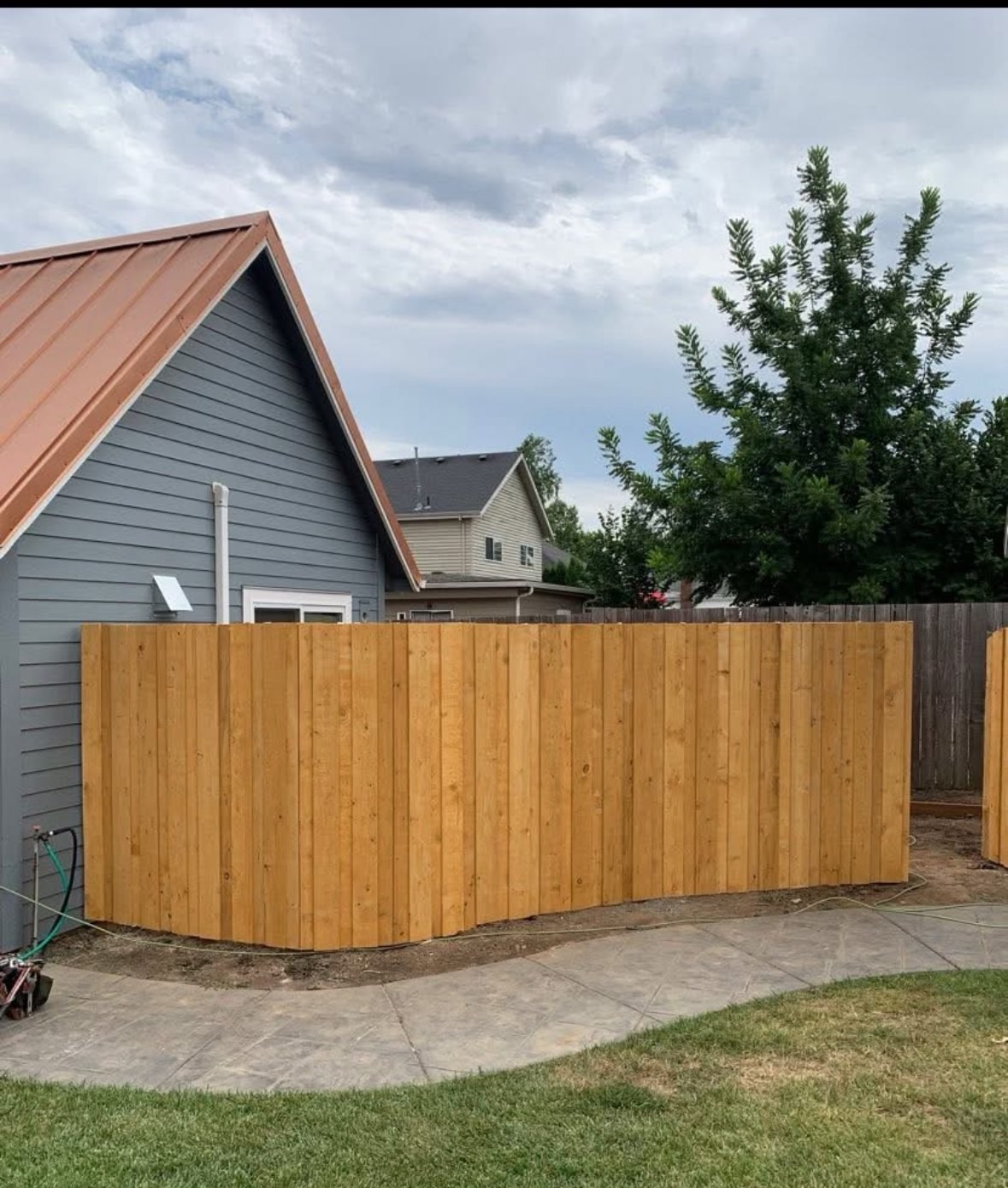
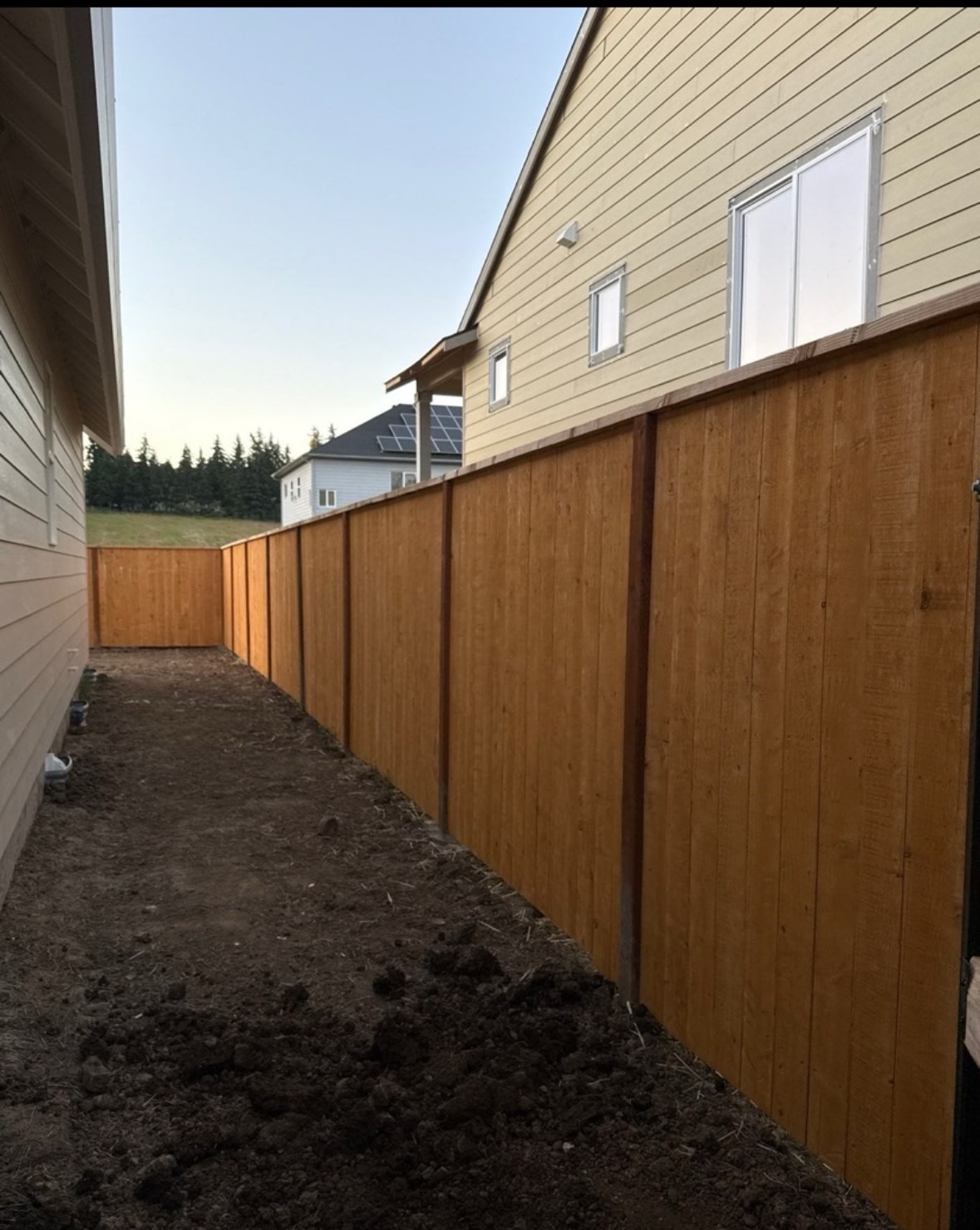
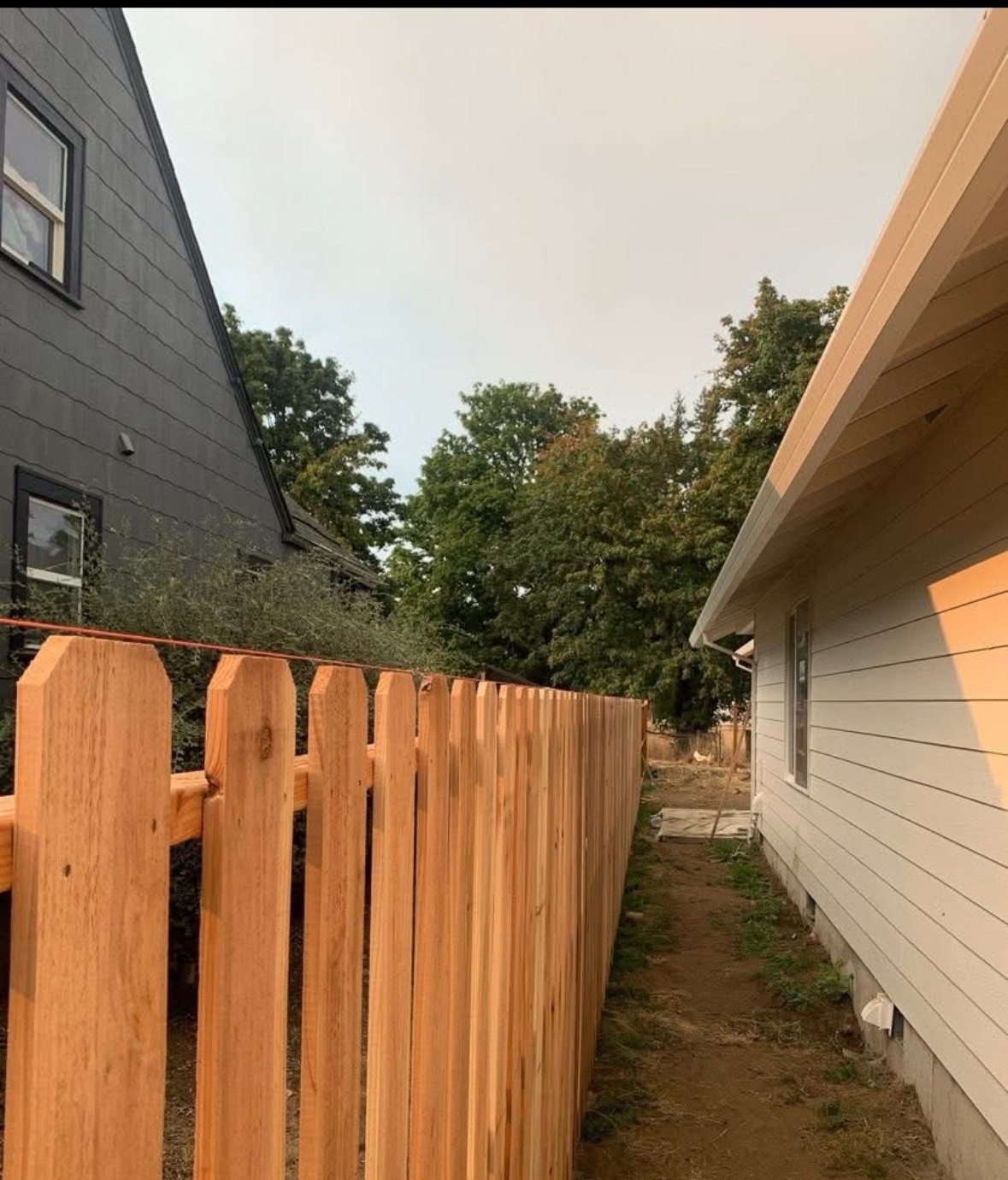
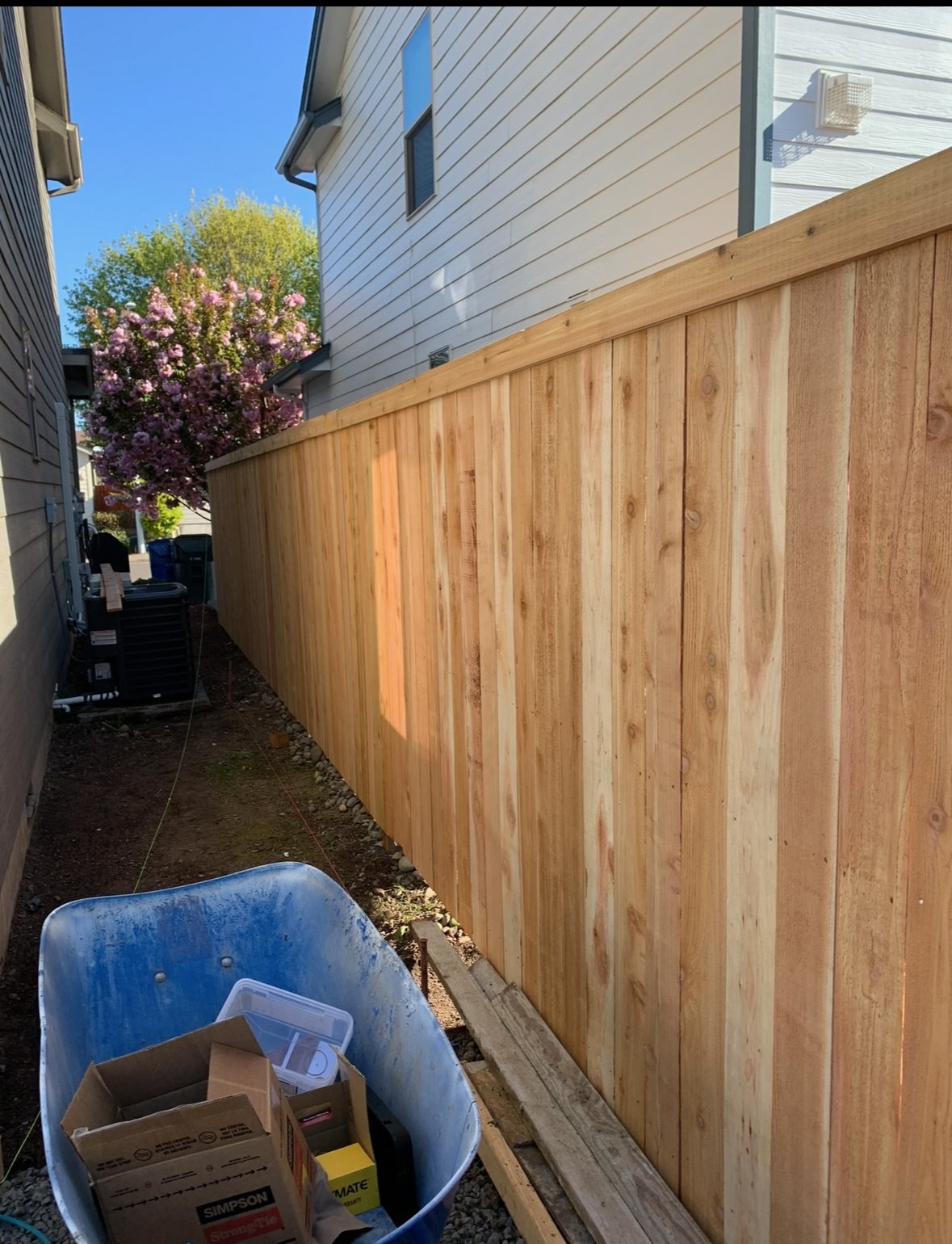
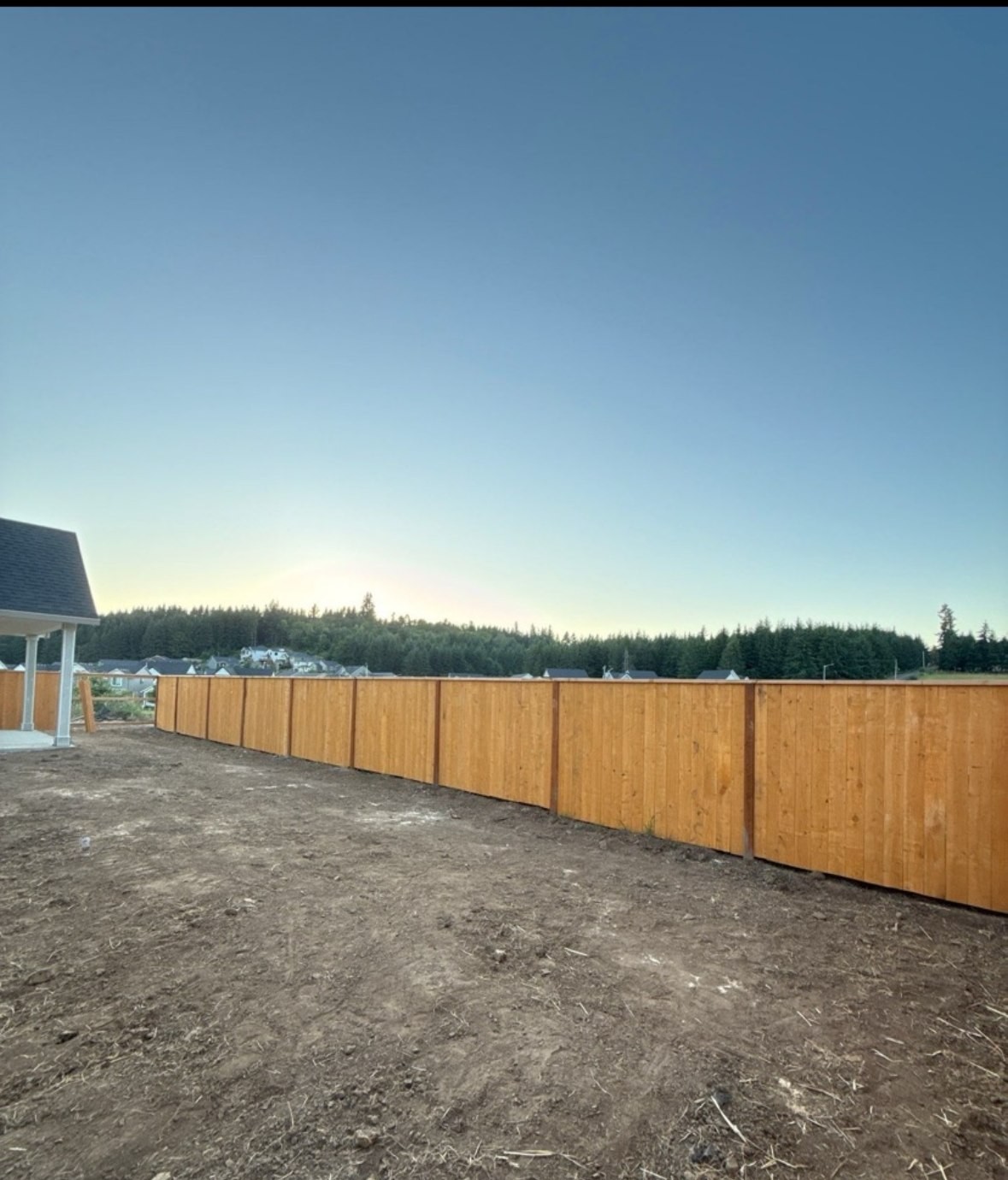
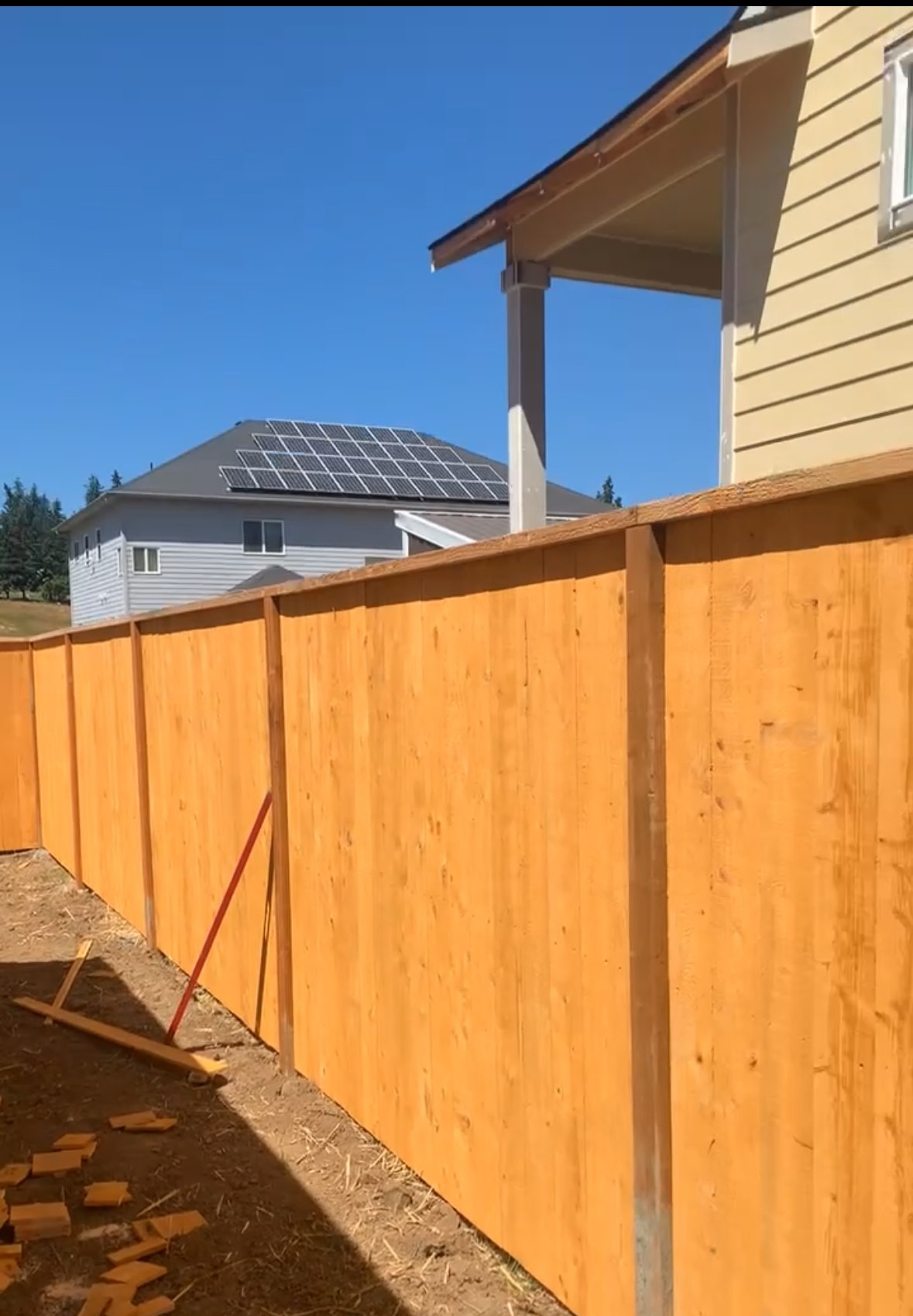
Fences we've actually built
Real jobs, photographed as they finished. No stock photography.
Questions Silverton homeowners ask
How tall can my fence be in Silverton?
Six feet along interior side and rear lines in R-1, R-5, RM-10 and RM-20 — the four zones Table 2.2.120.A actually covers. Out front on a standard interior lot it drops to 42 inches, and that 42 inches counts the fence plus any retaining wall, rock or railroad tie underneath it, measured from the grade closest to the street. Six feet is a zoning ceiling, not a permit threshold: no building permit raises it, though the code does allow those standards to be modified with approval of a planned development. Acreage Residential (AR) has no codified fence height at all, so call Planning if you're on AR land. See SDC Table 2.2.120.A and SDC 3.2.500(B)(1).
Do I need a permit to build a fence in Silverton?
Not at six feet or under. SDC 3.2.500(A) requires a building permit only for fences taller than six feet, and SDC 3.2.500(D)(3) adds that anything over six feet also has to be landscape-screened. In practice that threshold gets reached by fence-on-retaining-wall assemblies and commercial work, because no building permit lets you build a taller plain residential fence in R-1, R-5, RM-10 or RM-20. Retaining walls taller than four feet need a permit of their own, and masonry walls over four feet need the building official's review.
Can I put a six-foot fence in the front yard of my corner lot?
Yes, but only outside 50 feet from the through-curb intersection, and only if the fence is also set back at least five feet from the property line — SDC 3.2.500(B)(1) requires both. Inside that 50 feet you're limited to 42 inches. On top of that, no fence of any height may sit inside a vision clearance area, since SDC 3.2.500(A) requires every fence to be located outside one. The geometry lives in Figure 3.2.500 and Figure 3.1.200.N, and those are drawings rather than text — check them, or have Planning check them, before you set posts.
My back fence faces a street. Why can't I build it six feet?
That's a reverse frontage lot, and Table 2.2.120.A treats the rear line differently when it fronts a street. The default there is 42 inches. You can go to six feet, but only if you leave a five-foot landscaped buffer between the fence or wall and the sidewalk. It's the rule people most often find out about after the posts are in.
Are you licensed and insured?
Yes — Oregon CCB #257281, and insured. You can look the licence up yourself on the Oregon Construction Contractors Board site. Oregon requires contractors to put that number on their advertising, so if you're comparing quotes and someone doesn't show theirs, that's worth asking about.
Do you charge for an estimate?
No. Request a free quote and we'll follow up to learn more about the project — what you want built, repaired or replaced, and where the line runs.
Are you actually local?
Yes. Live Your Future Construction LLC is an Oregon company based in Albany, working Silverton and the mid-Willamette Valley. When you call, you get the person who'll be building your fence — not a scheduler in another state.
Other areas we cover
Fence rules change at every city line. These are written up the same way, city by city.
- Fence company in Salem, Oregon
- Fence company in Albany, Oregon
- Fence company in Keizer, Oregon
- Fence company in Corvallis, Oregon
- Fence company in Lebanon, Oregon
- Fence company in Sweet Home, Oregon
- Fence company in Philomath, Oregon
- Fence company in Independence and Monmouth, Oregon
- Fence company in Dallas, Oregon
- Fence company in Stayton, Oregon
- Fence company in Jefferson, Oregon
- Fence company in Millersburg and Tangent, Oregon